









New Fair Use Guide for Online Video
2009-05-18 20:39:05 Posted
by: ragaman7 Category: Copyright
The Center for Social Media at the American University of Washington have put together this little video explaining the previously released Code of Best Practices in Fair Use for Online Video, which we have mentioned on the blog before. Hoping to see many more of these in the future.
Here's the press release from the AU:
American University’s Center for Social Media and AU Washington College of Law's Program on Information Justice and Intellectual Property, in collaboration with Stanford Law School's Fair Use Project, are launching a new video explaining how online video creators can make remixes, mashups, and other common online video genres with the knowledge that they are staying within copyright law.
The video, titled Remix Culture: Fair Use Is Your Friend, explains the Code of Best Practices in Fair Use for Online Video, a first of its kind document—coordinated by AU professors Pat Aufderheide and Peter Jaszi—outlining what constitutes fair use in online video. The code was released July 2008.
“This video lets people know about the code, an essential creative tool, in the natural language of online video. The code protects this emerging zone from censorship and self-censorship,” said Aufderheide, director of the Center for Social Media and a professor in AU's School of Communication. “Creators, online video providers, and copyright holders will be able to know when copying is stealing and when it’s legal.”
Like the code, the video identifies six kinds of unlicensed uses of copyrighted material that may be considered fair, under certain limitations. They are:
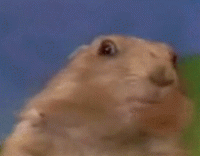
• Commenting or critiquing of copyrighted material • Use for illustration or example • Incidental or accidental capture of copyrighted material • Memorializing or rescuing of an experience or event • Use to launch a discussion • Recombining to make a new work, such as a mashup or a remix, whose elements depend on relationships between existing works For instance, a blogger’s critique of mainstream news is commentary. The fat cat sitting on the couch watching television is an example of incidental capture of copyrighted material. Many variations on the popular online video “Dramatic Chipmunk” may be considered fair use because they recombine existing work to create new meaning. “The fair use doctrine is every bit as relevant in the digital domain as it has been for almost two centuries in the print environment,” said Jaszi, founder of the Program for Information Justice and Intellectual Property and a professor of law in AU's Washington College of Law. “Here we see again the strong connection between the fair use principle in copyright and the guarantee of freedom of speech in the Constitution.” Remix Culture: Fair Use Is Your Friend is a collaborative project of the Center for Social Media—a center of AU's School of Communication—and the Program on Information Justice and Intellectual Property—a program of AU's Washington College of Law—along with Stanford Law School's Fair Use Project. It was funded by Google. UPDATE |
|
Blogs
Remixd
Digital Rights Ireland
Political Remix Video
This & That
Wreck & Salvage Blog
Imaginify.org
blogonandon
stanislas kazal underground blog
Niall Larkin
Recycled Cinema
Remix Theory
Art Threat
Lessig
JD Lasica
Blogorragh
Boing Boing
Darknet
Damien Mulley
Add a Blog
Categories
Remix Culture
Digital Rights
Copyright
Education
Business
Politics
Technology
Movies/TV
FilmMaking/Editing
Other
Recommended Reading
Add a Book

Pirate Cinema
Cory Doctorow
Republic, Lost: How Money Corrupte Congress -- And a Plan to Stop It.
Lawrence Lessig

Digital Copyright
Jessica Litman

The Video Vortex Reader
Edited by Giert Lovink and Sabine Niederer

Hillman Curtis on Creating Short Films for the Web
Hillman Curtis

Remix: Making Art and Commerce Thrive in the Hybrid Economy
Lawrence Lessig

Art of the Start
Guy Kawasaki

The Art of Innovation: Lessons in Creativity from IDEO, America's Leading Design Firm
Tom Kelley and Tom Peters

The Pirate' Dilemma
Matt Mason
Fans, Bloggers, and Gamers: Media Consumers in a Digital Age
Henry Jenkins

Promises to Keep
William W. Fisher

Copy Fights: The Future of Intellectual Property in the Information Age
Adam Thierer
The Future of Music
David Kusek, Gerd Leonhard
Freedom of Expression
Kembrew McLeod

The Future of Ideas
Lawrence Lessig

The Long Tail
Chris Anderson

The Cult of the Amateur
Andrew Keen

Convergence Culture
Henry Jenkins
Darknet: Hollywood's War Against the Digital Generation
JD Lasica
Free Culture
Lawrence Lessig

