









Featured Artist: Tasman Richardson
2009-10-10 19:49:45 Posted
by: ikat381 Category: Copyright
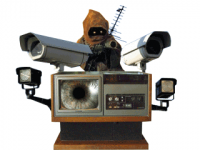
Tasman Richardson has been working with appropriated footage since the 90s and the “Jawa” style he developed has been adopted and imitated by a significant number of VJs and video artists. He works with potent sounds and images from commercial culture, which he cuts into small fragments and rhythmically reassembles. Richardson’s remix methods are rigorous and quite specific – designed to evoke a distinct emotional reaction from viewers. Jawa videos follow set standards regarding the number of frames that can be used in different cuts. There's also rules on how clips of particular durations should be combined. The clips are arranged rhythmically, but the visual and musical impact of the work are always operating simultaneously – neither ever takes priority over the other. In a Jawa video, the images you see are always accompanied by their original audio sources. Click here if you'd like to read Richardson's Jawa manifesto, which outlines his remixing influences and principles. As you watch a Jawa video it becomes impossible to mentally organize all of its rapid stimulus. Powerfully familiar images from mass culture replace each other so quickly that your brain gives up trying to sort them into any kind of narrative logic. The unrelenting rhythms and flashes of audiovisual stimulus create an overwhelming and numbing effect that is very hard to describe. Maybe it’s like watching your house burn down with fireworks going off in the background. Below are some youtube embeds of Tasman’s work, but if you’d like to see the videos in higher quality, you can visit his website at www.tasmanrichardson.com/video.htm UPDATE |
|
2009-06-25 03:49:24 Posted
by: ikat381 Category: Copyright
Aside from being made completely of appropriated footage, Pogo's movies fit very nicely into the "music video" tradition. They function to highlight and accompany his amazing musical tracks, which he composes out of samples usually taken from popular children's movies -- Harry Potter, The Secret Garden, Mary Poppins... In several tracks, Pogo will take small acapella bits from the films and rearrange them into entirely new melodies. The fragments of words and instruments build and ebb into engaging and haunting songs, with both the polished flow and dynamics of an accomplished DJ and a sense of that strange magic some of us might have felt when we were little children, sitting at the TV on our livingroom carpets and soaking in all the hypnotizing stimulus of our first disney films. Pogo mixes his movie sources with varying amounts of other samples and beats, but he also makes songs like "Mary's Magic," which is 100% composed of sounds from the movie "The Secret Garden." The track for Pogo's popular "Alice" video is 90% composed of the sounds from "Alice in Wonderland." Pogo typically chooses a single movie as the source material for his respective tracks and music videos. Once Pogo shifts to filmmaker mode, he rigorously arranges his visuals to draw in the viewer: he hits us with short clips of the images that correspond with his audio sources, he adjusts the speed of other scenes to fit the beat, he plays with jump cuts, repetition, he builds little variations by rotating or resizing the frame. Pogo uses an exhaustive range of video editing techniques to build a hypnotizing effect that seems well-suited for someone with such a solid musical background. And it obviously doesn't hurt that he often chooses such richly colorful movies as sources for his remixes. UPDATE |

|
2009-06-25 16:29:09 Posted
by: ikat381 Category: Copyright
Given that this trio of editors has chosen to give themselves the name "Wreck & Salvage," it's not surprising to find their body of work repeatedly raising the question of how we get value out of all the video footage that floods our lives. The sources W&S draw from are as varied as the internet: corporate news and commercials, internet memes, ephemeral daytime television, propaganda, archive footage, and plenty of amateur video, be it from youtube kids or soldiers serving in Iraq. Their artistic priorities are just as diverse: their Eadweard Muybridge tribute celebrates and explores the awkward magic of moving images; their "Saturday Morning" mix drives home the stifling forcefulness of ultra-bright, fast cutting, relentlessly mercenary children's programming; and the group doesn't mind putting together a quick detournement now and then to take the piss out of some of the more absurd excesses of right-wing propaganda (see "NOM: Gathering Gay Storm; SUPPENDAPO" for a recent example). W&S edits all this footage to look for ways to make it useful, either politically, socially, artistically, or all of the above. All three members of W&S are comfortable with nearly any digital editing technique you could think of. But perhaps their most important contribution to online remixing is what they've accomplished with "farming" for footage. Some of their most powerful remixes are made up of extensively researched footage collections organized around various themes or subject matter: Club Iraq combines a large number of amateur video clips from soldiers in the Iraq war to give us a powerful and disturbing picture of the culture of military occupation; their Mt. Rushmore remix collects amateur video of the monument and traces the diverse motivations for getting your own personal recording of an image you could find on a million postcards; "Diamonds are a Girl's Best Friend" builds a montage of soloists, amateur and professional, who appear in sequence and together sing the whole song. These exploratory remixes take the impulses of obsessive video-bin hunters and combine them with a movie editor's insight to sculpt raw footage into rich, rewarding videos. These guys advertise themselves as Wreckers and Salvagers, and they make good on that promise. UPDATE |

|
2009-06-18 11:46:34 Posted
by: ikat381 Category: Remix Culture
AMDS is the internet's reigning master of combining separate source footage into visually seamless masterpieces. He has built an impressively varied body of remix work -- from abstract style experiments to PSAs about gun control and traffic safety. But he is best known for tackling the biggest and loudest Hollywood franchises and mixing their heroes together into "dream matches" that draw millions of ecstatic viewers: Neo vs Robocop, Terminator vs Robocop, Arnie vs Sly... With the media industry spending huge sums of money trying to generate an appetite for more and more and more, it was only a matter of time before someone like AMDS came along with a do-it-yourself method for fulfilling the dearest wishes of the world's movie buffs. A few moments watching AMDS' remixes should convince you of his skills for digital effects and visual storytelling. He carefully manipulates the color hue of his material to create a vivid sense of unity between separate bits of source footage. He inserts quick, inventive digital-effects shots which place the different action heroes together in the same frame. This fall he will be releasing the third episode of his "Terminator VS Robocop" series. The film is 22 minutes long and the trailers AMDS has released for it are already pushing the limits of digital footage manipulation to levels that I've never seen outside of big-budget Hollywood productions. It would take me too long to itemize the extensive techniques AMDS employs to achieve his effects, so I'll just encourage you to go watch his work -- he has managed to take clips of Hollywood's most marketed action stars and transform them into movies where the biggest star is AMDS. UPDATE |

|
2009-06-09 16:03:11 Posted
by: ragaman7 Category: Copyright
Rick Falkvinge, the founder of the Swedish Pirate Party and the international politicized pirate movement, talks about the rise and success of pirates, and why pirates are necessary in today's politics. He'll also outline the next steps in the pirates' strategy to change global copyright laws.
The fight against copyright aggression tends to focus on economic aspects of the shift to a networked economy. Rick explains how this conflict is much more important than that: the fight against the copyright regime is about the right to fundamental civil liberties - down to the postal secret, whistleblower protection, freedom of the press, etc. UPDATE |

|
2009-06-08 15:12:02 Posted
by: ragaman7 Category: Copyright
[via TorrentFreak]
The Pirate Party has won a huge victory in the Swedish elections and is marching on to Brussels. After months of campaigning against well established parties, the Pirate Party has gathered enough votes to be guaranteed a seat in the European Parliament.
When the Swedish Pirate Party was founded in early 2006, the majority of the mainstream press were skeptical, with some simply laughing it away. But they were wrong to dismiss this political movement out of hand. Today, the Pirate Party accomplished what some believed to be the impossible, by securing a seat in the European Parliament.
With 99.9% of the districts counted the Pirates have 7.1 percent of the votes, beating several established parties. This means that the Pirate Party will get at least one, but most likely two of the 18 (+2) available seats Sweden has at the European Parliament.
When we asked Pirate Party leader Rick Falkvinge about the outcome, he told TorrentFreak: “We’ve felt the wind blow in our sails. We’ve seen the polls prior to the election. But to stand here, today, and see the figures coming up on that screen… What do you want me to say? I’ll say anything”
“Together, we have today changed the landscape of European politics. No matter how this night ends, we have changed it,” Falkvinge said. “This feels wonderful. The citizens have understood it’s time to make a difference. The older politicians have taken apart young peoples’ lifestyle, bit by bit. We do not accept that the authorities’ mass-surveillance,” he added. UPDATE |

|
2009-06-08 15:01:50 Posted
by: ragaman7 Category: Remix Culture
[via BoingBoing.net] Rogue archivist Carl Malamud sez,
"You may remember the FedFlix program from Public.Resource.Org. We got the National Technical Information Service (NTIS), a part of the U.S. Department of Commerce, to send a couple dozen videotapes every month. We digitized the tapes, and sent them back to the government with a DVD. No cost to .gov, and we got public domain data to post as high-res stock footage, plus great casual viewing on YouTube and the Internet Archive. The program went well for a year, the DC folks were happy, and I'm pleased to say we were able to renew the Joint Venture, but with a twist. They're now sending a minimum of 100 tapes a month and we have rights to all 6,000 masters in their warehouse.
The first batch of video arrived and the Public.Resource.Org Factory has been going full-tilt. We've put out an average of 11.5 hours of new video every day for the last 11 days, including some amazing previously unseen-on-the-Internet flicks featuring James Cagney, a bunch of Disney stuff, historical films by John Ford, and an amazingly clueless judicial film on "Special Needs Offender: Cyber Criminals." UPDATE |

|
2009-06-06 10:45:33 Posted
by: ragaman7 Category: Copyright
The ill-advised Design Piracy Prohibition act will potentially stifle creativity among independent designers in the American fashion industries. If a young designer is coming up with some new designs, if it is decided that these designs are too similar to other fashion designs produced by large corporatations, the young designer will find themselves litigated out of business. The trade-off in this scenario is too great. It's the same old story - large corporations get greater control and protection over existing designs, but designers find themselves restricted by a legal noose around their neck which results in less innovation and risk-taking for fear of being sued. The knock on effect for the general public / consumers is that there will be less innovative designs on the market.
Having said that, the benefits of such a law and the reasons being bandied around are that it is being brought in to prevent counterfeit knock-offs (often produced in China) that tend to hit US stores before the original designs and for a fraction of the price. Fashion designs are protected by copyright in many European countries, and the counter-argument goes that creativity has not been stifled in these countries but counterfeiting has been relatively deterred. Certainly room for debate...
"Under this legislation, however, designers will need to consult with a lawyer throughout the design process to ensure that every new design created could not subjectively be found at a later date to be "closely and substantially similar" to one protected in the Copyright registry...
Further, young, up-and-coming designers would be susceptible to legal intimidation from designing anything new at all, as they would likely not have the resources to fight a legal challenge in court...
While the bill purports to keep all fashion designs that have existed in the past free and open for all to use, the legislation would allow the ability to copyright non-original design elements in the public domain if arranged in an original way.
Moreover, since there is no test for originality, the registry will begin to be populated with designs that from the public domain. Thus, a designer who draws upon inspiration from the public domain, can easily find himself/herself stuck in costly litigation. UPDATE |

|
2009-05-28 15:07:25 Posted
by: ragaman7 Category: Remix Culture
Why Video Remix Creators Need a DMCA Exemption
Legal Analysis by Fred von Lohmann
If you are a vidder, a movie trailer mashup creator, YouTube movie critic, or anyone else who needs to take clips from DVDs in order to make an original remix video, you might be interested in the hearings held last week before the U.S. Copyright Office, where EFF and the Organization for Transformative Works squared off against the MPAA and DVD-CCA.
The MPAA says that ripping from a DVD is always illegal under the DMCA, even if it's done for the purpose of fair use. Since the Copyright Office is empowered to grant three-year exemptions to the DMCA, EFF has proposed a DMCA exemption for noncommercial remix creators.
At last week's hearings, the MPAA stuck by its old argument, saying that remix artists should just camcord off a flat screen TV (!) if they need clips. They even made a video showing how it's done!
After this MPAA demo, Georgetown Prof. Rebecca Tushnet, representing the Organization for Transformative Works, did a great job explaining why this is absurd. I did a YouTube video remixing her testimony with the MPAA camcording video, but here's an excerpt:
What we have here is essentially a digital literacy test and a digital poll tax imposed on fair use. The literacy test, as you may recall, required prospective voters to interpret an often arcane provision of the law. Here, the test proposed is that they understand that a digital file created in one way is illegal, while a similar, albeit degraded, digital file created another way is fine.
Then there’s the poll tax: you have to purchase the proper equipment to create the second digital file. It’s expensive and nonstandard for an individual artist—we were offered the prospect of using a $900 camera, plus a several-hundred-dollar tripod, plus a large flat-screen TV in a large, completely darkened room. The noncommercial artists we represent are often pink-collar workers; $900 is regularly more than a month’s rent for them; it would be a crippling requirement. And they don’t ever get paid for the works they create. This is not an investment for them. This is their free speech; this is how they react to popular culture—addressing it, critiquing it, changing it.
And the poll tax is inherent in the responses from the opponents of an exemption: their argument that camcorders somehow preserve the technology inherently presumes that the camcorder solution is one that won’t be used by fair users and therefore fair uses will be suppressed. To the contrary, the possibility of camcording proves that the proposed exemption will not cause any harm to the opponents. They say camcording is easy and is good enough to watch. In that case, that’s the mode pirates will use. They cannot maintain that camcording is a substitute for fair use clipping and also that the exemption will degrade protection for CSS compared to camcording.
We got rid of the literacy test and the poll tax because they deterred people from participating –people whose voices weren’t heard otherwise. We did this even though some brave people defied the laws and persevered. Some even managed to register and vote. The problem was all the people who didn’t have the time or the energy or the resources to persevere, and all those who looked at the costs and didn’t even bother to try. That’s the problem here.
If you care about remix creativity, it's worth reading Prof. Tushnet's entire testimony.
The Copyright Office is expected to rule on EFF's proposed DMCA exemption in October. UPDATE |

|
2009-05-28 12:44:59 Posted
by: ragaman7 Category: Copyright
EFF Launches 'Teaching Copyright' to Correct Entertainment Industry Misinformation
New Curriculum Gives Students the Facts About Their Digital Rights and Responsibilities
San Francisco - As the entertainment industry promotes its new anti-copying educational program to the nation's teachers, the Electronic Frontier Foundation (EFF) today launched its own "Teaching Copyright" curriculum and website to help educators give students the real story about their digital rights and responsibilities on the Internet and beyond.
The Copyright Alliance -- backed by the recording, broadcast, and software industries -- has given its curriculum the ominous title "Think First, Copy Later." This is just the latest example of copyright-focused educational materials portraying the use of new technology as a high-risk behavior. For example, industry materials have routinely compared downloading music to stealing a bicycle, even though many downloads are lawful, and making videos using short clips from other sources is treated as probably illegal even though many such videos are also lawful. EFF created Teaching Copyright as a balanced curriculum encouraging students to make full and fair use of technology that is revolutionizing learning and the exchange of information.
"Today's tech-savvy teens will grow into the artists and innovators of tomorrow," said EFF Staff Attorney Corynne McSherry. "They need to understand their digital rights and responsibilities in order to create, critique, and comment on their culture. This curriculum fills an educational void, introducing critical questions of digital citizenship into the classroom without misinformation that scares kids from expressing themselves in the modern world."
The Teaching Copyright curriculum is a detailed, customizable plan that connects students to contemporary issues related to the Internet and technology. Teaching Copyright invites discussion about how creativity is enabled by new technologies, what digital rights and responsibilities exist or should exist, and what roles students play as users of technology. The website at www.teachingcopyright.org includes guides to copyright law, including fair use and the public domain.
"Kids are bombarded with messages that using new technology is illegal," said EFF Activist Richard Esguerra. "Instead of approaching the issues from a position of fear, Teaching Copyright encourages inquiry and greater understanding. This is a balanced curriculum, asking students to think about their role in the online world and to make informed choices about their behavior."
The Teaching Copyright curriculum was developed with the input of educators from across the U.S. and has been designed to satisfy components of standards from the International Society for Technology in Education and the California State Board of Education.
Learn more about Teaching Copyright:
http://www.teachingcopyright.org/
Contacts:
Richard Esguerra Activist Electronic Frontier Foundation richard@eff.org Corynne McSherry Staff Attorney Electronic Frontier Foundation corynne@eff.org UPDATE |

|


Blogs
Remixd
Digital Rights Ireland
Political Remix Video
This & That
Wreck & Salvage Blog
Imaginify.org
blogonandon
stanislas kazal underground blog
Niall Larkin
Recycled Cinema
Remix Theory
Art Threat
Lessig
JD Lasica
Blogorragh
Boing Boing
Darknet
Damien Mulley
Add a Blog
Categories
Remix Culture
Digital Rights
Copyright
Education
Business
Politics
Technology
Movies/TV
FilmMaking/Editing
Other
Recommended Reading
Add a Book

Pirate Cinema
Cory Doctorow
Republic, Lost: How Money Corrupte Congress -- And a Plan to Stop It.
Lawrence Lessig

Digital Copyright
Jessica Litman

The Video Vortex Reader
Edited by Giert Lovink and Sabine Niederer

Hillman Curtis on Creating Short Films for the Web
Hillman Curtis

Remix: Making Art and Commerce Thrive in the Hybrid Economy
Lawrence Lessig

Art of the Start
Guy Kawasaki

The Art of Innovation: Lessons in Creativity from IDEO, America's Leading Design Firm
Tom Kelley and Tom Peters

The Pirate' Dilemma
Matt Mason

Fans, Bloggers, and Gamers: Media Consumers in a Digital Age
Henry Jenkins

Promises to Keep
William W. Fisher

Copy Fights: The Future of Intellectual Property in the Information Age
Adam Thierer

The Future of Music
David Kusek, Gerd Leonhard
Freedom of Expression
Kembrew McLeod

The Future of Ideas
Lawrence Lessig

The Long Tail
Chris Anderson

The Cult of the Amateur
Andrew Keen

Convergence Culture
Henry Jenkins
Darknet: Hollywood's War Against the Digital Generation
JD Lasica
Free Culture
Lawrence Lessig

